
Milk Run Logistics in India: How Multi-Point Delivery Helps Distributors Save Costs
Blogs
Milk Run Logistics in India: How Multi-Point Delivery Helps Distributors Save Costs
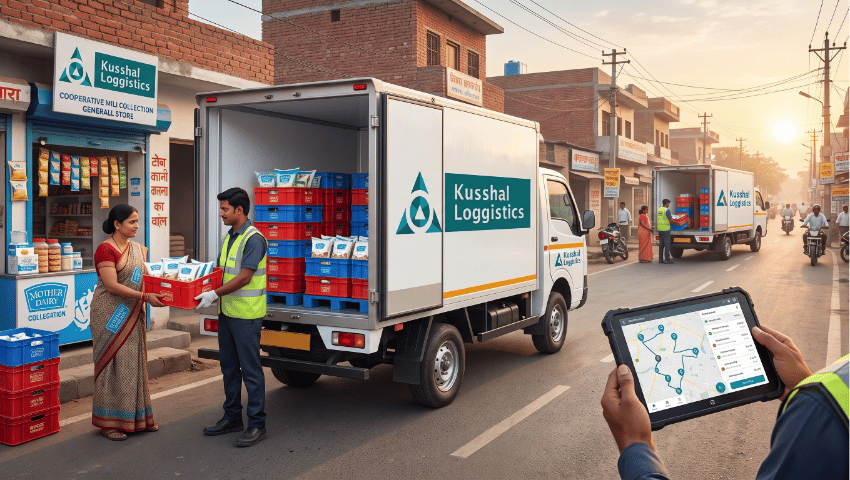
Transportation is usually one of the largest operational issues when distributors begin to expand to different regions. Daily delivery of products to various dealers, retailers, stockists and channel partners can rapidly escalate logistics costs. Most companies end up sending individual cars to various destinations only to discover later that they are wasting a significant percentage of their transportation expenses on inefficient vehicle transportation. This is where milk run logistics has come in as a viable solution to businesses that seek to optimise costs without affecting the level of service.
When you are dealing with a distribution network in Mumbai, Delhi, Pune, Gujarat, Nagpur or any other emerging market in India, then you have likely experienced this challenge yourself. What do you do to deliver products to 15 or 20 different customers without sending out several vehicles? More to the point, how do you maintain transportation expenses at a low level and at the same time make deliveries on time? The solution is usually a well-designed milk run logistics model with an experienced logistics partner like Kusshal Loggistics.
What Is Milk Run Logistics?
In case this is the first time you are hearing this term, you may be wondering what milk run logistics is. In simple terms, it is a transportation model in which a vehicle is used to transport goods to several customers on a pre-determined route. The same vehicle is used to serve multiple delivery points instead of a single vehicle to a single customer or a single destination before going back to the warehouse or its next route.
This concept is not considered a transportation method at Kusshal Loggistics. It is regarded as a supply chain optimisation strategy. Businesses can save a lot of money on transportation costs by consolidating several deliveries into one route and still delivering goods at the same time. In the case of distributor networks that deal with high volumes of products in different locations, this strategy can generate significant savings in the long term.
The reason why Traditional Distribution Models fail.
Most distributors still operate transportation models that were developed many years ago. A vehicle is sent whenever an order is received. Although this approach seems straightforward on paper, it can lead to a number of inefficiencies. Cars can be discharged half-full. Routes may overlap. Drivers can pass through the same roads several times in a day. The cost of fuel is ever-growing, and the productivity of the fleet is low.
Kusshal Loggistics often collaborates with companies that have precisely these issues. The company has experienced the impact of transportation costs slowly consuming profitability when distribution networks are not optimised. What seems to be a transportation problem is usually a route planning problem. Through the analysis of delivery patterns and the consolidation of shipments in an intelligent manner, most of these inefficiencies can be removed without compromising the level of customer service.
The way Multi-Point Deliveries generate Real Cost Savings.
The greatest benefit of milk run logistics is enhanced utilisation of vehicles. Consider a distributor with 18 retailers in a city or industrial area. In a formal model, multiple vehicles might be needed to make all deliveries. Every vehicle has expenses in terms of fuel, maintenance, tolls and manpower. Nevertheless, when the routes are planned properly, one vehicle may frequently serve several customers on a single well-planned trip.
This is the point at which Kusshal Loggistics develops value to its customers. Their transport and distribution services are not meant to transport goods between two points but to make the routes as efficient as possible. Each kilometre covered is to create value. Through minimising empty trips, enhancing load utilisation and consolidating deliveries, customers are able to attain lower transportation costs throughout their distribution networks.
The Warehousing Role in the Successful Milk Run Operations.
A lot of individuals believe that milk run logistics is all about transportation. As a matter of fact, the milk run implementation starts within the warehouse. Products have to be arranged, collected, packed and staged before a vehicle begins its trip, in a way that facilitates effective unloading at various delivery points. Even the most thought-out transportation route can be easily disrupted by poor coordination in the warehouse.
This is among the reasons why Kusshal Loggistics is in a unique position to facilitate milk run operations. The company has over 4 lakh square feet of warehouse space and has experience in dealing with more than 10,000 SKUs, so it knows how warehousing and transportation should collaborate. Their combined logistics strategy enables the inventory management, order processing, and distribution planning to be a networked system, not individual activities.
Why Distributor Networks Benefit The Most
The largest beneficiaries of milk run logistics are perhaps distributor networks. The majority of distributors make deliveries to various destinations daily. Some customers require small quantities. Others require frequent replenishment. Handling such deliveries separately usually leads to high transportation expenses that slowly diminish profitability.
Kusshal Loggistics is aware of these facts since distributor logistics constitutes a major portion of their operational knowledge. The company assists enterprises in developing organised delivery schedules to enhance transportation efficiency, whether it is to retail outlets, dealers, wholesalers, or channel partners. Rather than considering each delivery as a one-off movement, the routes are planned to reach several customers and ensure a consistent delivery schedule.
The use of GPS-Enabled Fleet Management in Milk Runs.
One of the parts of the equation is route planning. Visibility is also important once vehicles are on the road. Companies would like to know the location of their deliveries, whether the routes are being taken properly and whether the deliveries are being made on time. Without real-time visibility, managing multi-point distribution becomes much more difficult.
Kusshal Loggistics has GPS-enabled vehicles to support its transportation activities in its fleet. This visibility enables businesses to monitor vehicle movement, route compliance, and have more control over distribution operations. To customers with large regional distribution networks, this transparency assists in enhancing planning, enhancing customer communication, and minimising uncertainty during the delivery process.
A Real-Life Application of Milk Run Logistics.
Take the example of a company that provides products to retailers in Mumbai and other industrial areas. In a conventional transportation model, single deliveries can involve several vehicles departing the warehouse during the day. There are those vehicles that can run below capacity and others that can take a lot of time in moving between destinations without sufficient freight to cover the cost.
In the case of Kusshal Loggistics, the approach to the same operation can be different. Orders are consolidated in the warehouse, the routes are planned strategically, and the deliveries are grouped according to the geography and customer needs. One vehicle can make 15-20 deliveries in a single route. The outcome is reduced transportation expenses, better utilisation of assets and a more streamlined distribution process.
Industries that have complicated distribution needs.
The logistics requirements of not all industries are the same. Some businesses deal with thousands of product variations. Some have seasonal inventory cycles. Some industries need to be replenished regularly in various locations. This complexity further increases the importance of route planning and transportation management.
Kusshal Loggistics has gained experience in serving companies in various industries. Their published case studies show how they have assisted fashion companies to streamline inventory operations, assisted tile manufacturers to streamline factory-to-consumer distribution, and assisted plumbing distributors to streamline logistics systems. This real-life experience allows the company to develop milk run strategies that are in line with the business needs of the real world and not generic logistics theories.
The reason why technology and experience should collaborate.
Technology alone cannot solve logistics challenges. Most companies invest in tracking systems and software, yet they are still grappling with transportation inefficiencies. On the other hand, experience without visibility can limit operational control. Milk run logistics needs both of these elements to be successful.
Kusshal Loggistics integrates technology-based logistics services with operational experience gained over years of operation in the transportation and distribution services. Their customer-centric strategy is based on trust, transparency, safety, and customisation. This combination enables businesses to enjoy the benefits of structured processes and, at the same time, have the flexibility to respond to the evolving customer needs and market conditions.
Developing A Distribution Model To Grow.
Scalability is one of the largest benefits of milk run logistics. Distribution complexity increases with the growth of businesses. An increased number of customers, an increased number of delivery points, and an increased number of products can easily pose a logistical problem. The mere introduction of vehicles can address the short-term capacity problems, but it does not necessarily establish an effective distribution network.
Kusshal Loggistics assists companies in creating logistics models that can be expanded as they grow. Through route optimisation, better coordination of the warehouse and development of organised delivery systems, companies are able to increase their customer base without the same growth in transportation costs. This enables the distribution networks to be efficient even when volumes grow with time.
The reason why more businesses are opting to use Kusshal Loggistics.
Businesses today demand more than just transportation services from their logistics partners. They desire solutions that are integrated and include warehousing, inventory management, route planning, distribution execution, and operational visibility. They require partners who can manage complexity and still be efficient.
This integrated approach has helped Kusshal Loggistics to establish its reputation. The company has over 250 employees, a comprehensive warehousing network, GPS-based transportation services, and experience in various industries to assist businesses in optimising supply chains and enhancing distribution performance. They continue to focus on assisting customers to be ahead of the competition with smarter logistics solutions.
Conclusion
Milk run logistics is a viable and tested solution for distributors who want to lower transportation expenses and enhance efficiency in delivering their products. Through combining several deliveries into well-thought-out routes, companies will be able to enhance the use of vehicles, lower the costs of operations, and establish more effective distribution channels. The trick, though, is in implementation.
Kusshal Loggistics unites the key elements needed to achieve successful milk run operations. Out of the 4 lakh square feet of warehousing area and the capacity to handle over 10,000 SKUs, to GPS-enabled transportation services and customer-first operating philosophy, the company offers businesses the infrastructure and expertise to optimise regional distribution. Milk run logistics is no longer just a transportation strategy as supply chains are becoming more competitive. In the case of Kusshal Loggistics, it is an effective means of developing a more efficient, scalable, and cost-effective distribution network.