
Monsoon-Ready Logistics in India: How Businesses Can Avoid Transport Delays and Cargo Damage
Blogs
Monsoon-Ready Logistics in India: How Businesses Can Avoid Transport Delays and Cargo Damage
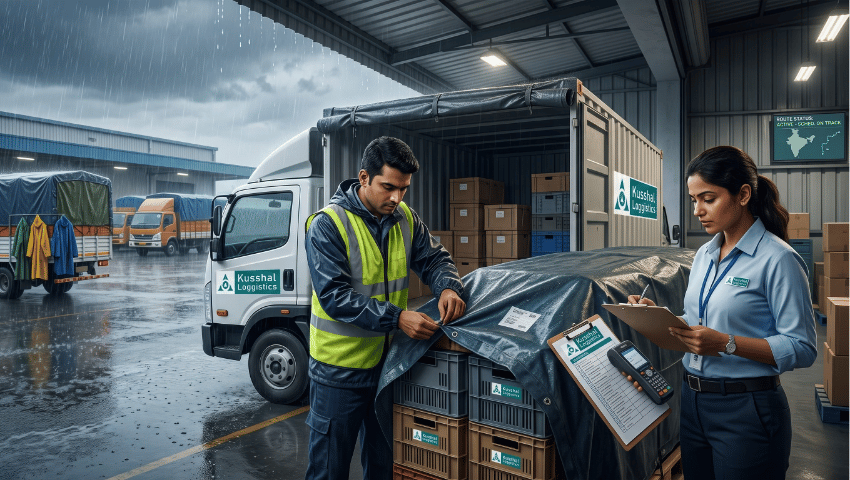
As the monsoon season approaches India, manufacturing, distribution, retail, and e-commerce businesses begin to prepare to face a new type of challenge. Although rainfall is vital to the nation, it tends to cause inconveniences in the transportation systems, warehousing activities, and supply chains. The roads get crowded, transit time becomes unpredictable, and cargo security becomes an increasing issue. When your business relies on the timely deliveries and continuous flow of inventory, then monsoon preparedness cannot be an afterthought.
The real question for many companies is not whether delays will take place but how well they can be handled. This is where a seasoned logistics partner can come in handy. Kusshal Loggistics has been assisting businesses in developing efficient and scalable supply chain operations using integrated warehousing, transportation, and logistics solutions over the years. The company has a customer-first strategy and a robust operational base that enables customers to remain ready even when external circumstances are difficult.
Why Monsoon Logistics Requires More Than Just Transportation
Most companies assume that the logistics issues associated with the monsoon season start and stop with the delay of transportation. In reality, the impact is much broader. A late vehicle may impact warehouse schedules, inventory planning, retailer commitments and customer deliveries. What begins as a transportation problem can easily become a supply chain problem, which impacts various departments of a business.
Kusshal Loggistics takes a holistic view of monsoon preparedness as opposed to transportation alone. The company assists customers in developing greater operational resilience during the rainy season by combining warehousing, transport management, inventory management, and logistics consulting. This combined strategy enables companies to react more quickly and continue to operate even when external factors are unpredictable.
The Hidden Cost of Waiting for Problems to Happen
Reaction to disruption after it has taken place is one of the most widespread errors that businesses commit. Production schedules can be impacted by the time a shipment is delayed. Customer orders might be jeopardised before inventory shortages are even noticeable. Businesses that are dependent on reactive planning usually struggle to regain lost time and operational effectiveness during the monsoon season.
At Kusshal Loggistics, planning begins way before the first heavy rainfall hits. The company collaborates with customers to determine supply chain risks, transportation dependencies, inventory requirements, and warehousing needs ahead of time. This proactive approach allows businesses to minimise disruptions instead of constantly responding to them. In logistics, preparation often becomes the difference between maintaining service levels and facing costly delays.
How Strong Warehousing Reduces Monsoon Risk
During the rainy season, warehousing is one of the most useful assets. Companies that rely solely on long-distance delivery are more prone to risks since inventory is still susceptible to road incidents. Strategic warehousing provides a buffer that enables firms to keep serving their customers even when there are temporary challenges in the transportation networks.
Kusshal Loggistics operates more than 4 lakh square feet of warehouse space, which gives the customers the flexibility to keep inventory nearer to demand centres. This is particularly crucial in monsoon months when the replenishment cycles can be less predictable. Businesses can use strategically controlled inventory to ensure the smooth running of the business and customer satisfaction, as opposed to depending on the incoming shipments.
Why Inventory Visibility Matters During Monsoon Months
Consider a distributor with thousands of product lines in different regions. An abrupt transport failure may cause confusion about the stock levels, replenishment schedules, and customer orders. Lack of proper inventory visibility makes it hard to make decisions, and operational risks are high.
The management of over 10,000 SKUs in various customer needs has provided Kusshal Loggistics with a wide experience in inventory management and warehouse operations. The company realises that visibility is not merely about being aware of what inventory is available. It is concerned with knowing the location of products, the speed at which they can be shipped and the positioning of inventory to reduce the effects of delays in transportation.
Protecting Cargo from Moisture and Weather Damage
Although the most attention is usually paid to delivery delays, cargo damage can also have equally severe repercussions. Exposure to rainwater, excess moisture, mishandling, and poor storage facilities can spoil products even before they reach their destination. To manufacturers, distributors, and e-commerce companies, spoiled inventory can be directly translated into losses and customer dissatisfaction.
Kusshal Loggistics lays a lot of stress on the safe handling of inventory and operational discipline in the logistics process. Cargo integrity is a priority whether the products are stored in warehouses or are being transported via transportation networks. This emphasis on safety is in line with the overall company dedication to providing logistics solutions that are founded on trust, transparency, and reliability.
GPS-Enabled Fleet Operations Create Greater Control.
Uncertainty is one of the greatest frustrations that businesses face when monsoon disruptions occur. Customers ask for delivery updates. Sales teams request shipment status reports. The procurement departments desire to see the incoming inventory. It is hard to manage expectations without the right information.
Kusshal Loggistics is able to overcome this challenge through its GPS fleet operations. Live tracking of vehicles enables logistics teams to monitor the movement of shipments more efficiently and react promptly to changes in conditions. In times of heavy rain, access to precise transportation data can assist businesses in making sound decisions instead of making assumptions or waiting to get updated.
Supporting Manufacturers Through Seasonal Supply Chain Challenges
The monsoon season is usually associated with some of the most complicated logistics issues in manufacturing businesses. Late deliveries of raw materials may slow production, and late deliveries of finished goods may impact customer commitments. Even minor disturbances in a highly competitive industry can cause a lot of pressure in operations.
Kusshal Loggistics has extensive experience supporting manufacturers through customised logistics and supply chain solutions. The fact that the company has been working with other industries like fashion, tiles, plumbing products and other distribution-based industries shows that the company is able to handle various logistics needs. Kusshal Loggistics assists manufacturers to ensure stability in operations during the rainy season by aligning warehousing, transportation, and inventory management strategies.
Distribution Networks Need Reliability, Not Just Capacity
A lot of logistics companies are concerned with the transportation of goods between two places. However, distribution efficiency requires much more than transportation capacity. Companies require reliable delivery times, synchronised inventory flow, precise shipment tracking, and flexible logistics services. These needs are even more urgent during the monsoon season.
Kusshal Loggistics integrates transportation and distribution services into a wider supply chain. The company does not consider transportation as a stand-alone activity but rather as a way of making sure that inventory gets to the right place at the right time with minimal disturbance. This will assist the customers in ensuring that they are able to sustain a higher level of service even when the weather is unfavorable.
How Kusshal's Customer-First Approach Makes a Difference
All businesses have their own logistical problems during the monsoon season. A manufacturer might be worried about the continuity of production. A delivery performance may be the focus of an e-commerce company. A distributor can focus on the availability of inventory in various places. Due to these variations, the general logistics solutions do not meet the unique operational requirements.
Kusshal Loggistics has established its reputation based on the customer-first philosophy that focuses on customisation and flexibility. The company does not provide one-size-fits-all solutions but collaborates with customers to learn about their operational goals and supply chain needs. This enables businesses to implement logistics strategies that align with their specific challenges and growth goals.
Building a Supply Chain That Performs in Every Season
Monsoon preparedness cannot be considered a seasonal project. Companies investing in more robust supply chain bases tend to gain over the year. Enhanced inventory visibility, enhanced warehousing, enhanced transportation planning, and integrated logistics management keep on providing value even after the rainy season is over.
Having over 250 employees, a well-developed warehousing network, GPS-based transportation services, and experience in 3PL logistics services, Kusshal Loggistics assists companies in developing supply chains that are designed to perform over the long term. The aim is not merely to endure seasonal shocks but to establish logistics operations that are efficient, scalable, and reliable in the face of varying conditions.
Conclusion
The uncertainty that comes with every monsoon season is unpredictable, yet uncertainty does not necessarily translate into disruption. Companies that plan, enhance inventory placement, enhance transportation visibility, and collaborate with seasoned logistics companies are much better placed to ensure continuity in operations. It is not the problem of not getting wet. The issue is that the rain should not affect the business performance.
This is where Kusshal Loggistics comes in to provide value. The company enables businesses to overcome the challenges associated with monsoon seasons with more confidence through integrated 3PL services, over 4 lakh square feet of warehouse infrastructure, over 10,000 SKU management, GPS-enabled fleet operations, and a customer-first philosophy. To manufacturers, distributors, retailers, and e-commerce brands that require reliable logistics services, Kusshal Loggistics offers the operational capabilities to ensure that supply chains run smoothly despite the weather.