
Part Load Transportation in India: A Cost-Saving Guide for B2B Distribution
Blogs
Part Load Transportation in India: A Cost-Saving Guide for B2B Distribution
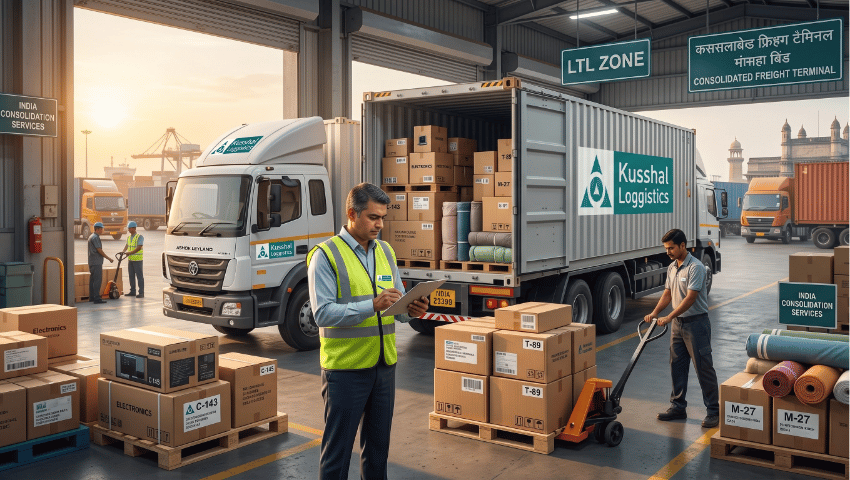
The initial thought that often crosses the mind of businesses when they consider cutting logistics costs is negotiating freight rates. Although freight rates do have an impact, they are not necessarily the most significant factor in the increase in transportation costs. The fact is that most companies are making losses due to paying for truck space that they are not utilising. This is particularly prevalent with distributors, manufacturers, wholesalers and expanding businesses that ship products on a regular basis but do not necessarily have sufficient volume to fill an entire truck.
Consider a plumbing products distributor in Mumbai getting orders placed by dealers in Pune, Nashik, Nagpur and Ahmedabad. Each order is significant, and each customer wants to receive the order on time. Waiting until sufficient inventory is on hand to fill a dedicated truck can, however, delay dispatches. Conversely, dispatching a half-full vehicle raises transportation expenses. This is precisely where part-load transportation can add value to businesses that desire efficiency and flexibility.
This is an issue that the team at Kusshal Loggistics has to deal with on a regular basis when assisting B2B distribution networks in various industries. Businesses have, over the years, realised that transportation cannot be run separately from warehousing, inventory planning and supply chain strategy. Rather, all these functions should collaborate to produce an effective distribution model at a low cost. This philosophy is at the core of the Kusshal Loggistics approach to logistics management.
The reason why businesses tend to pay more than is necessary.
Transportation costs are fixed in the minds of many companies. They presume that after booking a vehicle, the cost is inevitable. However, the real question is whether the vehicle is being utilised efficiently. A truck that is only 40% full is still using fuel, driver resources, toll fees, and operating costs like a full truck. The outcome is an increased cost of transportation per unit delivered.
This is even more critical to businesses that have many SKUs and serve customers in various locations. Kusshal Loggistics is not unfamiliar with this challenge since it handles over 10,000 SKUs in its logistics. Transportation planning becomes much more complicated than merely hiring vehicles when inventory movement is concerned with thousands of products that are transported to various markets at various times. It requires intelligent consolidation and distribution planning.
Why is Part Load Transportation So Effective?
Part load transportation enables various shipments from various businesses to share the space on a truck. Businesses do not pay the entire capacity of a truck, but only the space they need. This saves costs immediately, and goods are not held up in the supply chain without any justifiable reason.
The concept sounds simple, but successful execution requires strong operational capabilities. The consolidation of shipments, the optimisation of routes, the coordination of deliveries, and the provision of customers with the correct information during the journey should be performed. This is the reason why companies are more willing to engage with logistics companies that are able to offer transportation services, warehousing, and distribution services under a single roof.
The Relationship between Warehousing and Transportation.
Among the greatest errors that businesses commit is the separation of warehousing and transportation as two different processes. As a matter of fact, the two functions have a direct influence on one another. Effective transportation begins with the effective management of inventory, correct order processing, and efficient dispatch planning.
Having more than 4 lakh square feet of warehouse space under management, Kusshal Loggistics assists businesses in establishing a more powerful linkage between storage and distribution. Businesses are also enjoying the advantage of a smooth process where warehousing and transportation are one integrated system instead of having to transfer products between service providers. This minimises delays in handling, enhances dispatch speed, and facilitates more efficient part load movements.
The Economics of Multi-Drop Deliveries.
Assume that a manufacturer has to distribute products to five distributors in Maharashtra. Five different vehicles would be hired, and this would raise transportation expenses. Nevertheless, with a carefully designed multi-drop delivery model, one vehicle can serve many destinations in a single route.
Kusshal Loggistics applies distribution-oriented planning to assist companies in optimising vehicle usage without compromising delivery promises. The emphasis is not on the transportation of goods between Point A and Point B but on the development of distribution channels that can facilitate the efficiency of the supply chain in the long term. This is especially useful to companies that have extensive dealer and distributor networks.
The reason is that expanding businesses are more inclined to flexible transportation models.
Shipment patterns are less predictable as businesses grow. New markets are created. Distributor networks grow. Product portfolios increase. What was effective in transportation two years ago might not be effective in supporting the current needs.
This is among the reasons why most organisations are abandoning the inflexible transportation models and adopting more flexible logistics approaches. Kusshal Loggistics facilitates this change by providing scalable transportation and distribution services that can keep up with business expansion. Regardless of whether the shipments are a few pallets or a number of consignments in various cities, the goal is the same: to enhance efficiency without complicating logistics.
Technology is a Key Factor.
Paperwork and phone calls are no longer the sole drivers of modern logistics. Businesses desire visibility, accountability, and real-time information. Customers desire to have the right delivery schedules, and supply chain managers desire to have better control of the inventory flow.
Kusshal Loggistics fulfills these expectations by providing GPS-based transportation services that enhance shipment visibility and operational transparency. This is a technology-based solution that enables companies to make quicker decisions, reduce uncertainty and have greater control over their distribution channels. Customer service levels also go up when transportation visibility is enhanced.
Part Load Transportation is not all about saving money.
Part load transportation is first considered by many businesses due to the desire to cut down on freight costs. But the advantages go far beyond that. The quicker deliveries, enhanced inventory turnover, enhanced vehicle utilisation, less warehousing pressure, and enhanced distribution flexibility all lead to enhanced business performance.
This is the wider view of why Kusshal Loggistics emphasises integrated logistics solutions as opposed to isolated transportation services. It is not just about transporting goods. It is aimed at assisting businesses to develop supply chains that enable growth, responsiveness, and long-term competitiveness in the ever-challenging markets.
Conclusion
Part load transportation has emerged as a significant business strategy that companies wish to use to maximise distribution expenses without affecting the quality of services. Nevertheless, shared truck space is not enough to attain meaningful results. It involves a close coordination of warehousing, inventory management, transportation planning, technology, and distribution implementation.
This is where Kusshal Loggistics develops a unique advantage. Through integrating transport and distribution services with large warehousing facilities, GPS-enabled fleet management, supply chain knowledge, and a customer-centric approach, Kusshal Loggistics assists companies to create smarter and more cost-effective distribution networks. Part load transportation is much more useful to organisations that seek to enhance B2B logistics performance in India when it is backed by an integrated logistics partner that has a comprehensive knowledge of the entire supply chain journey.
FAQs
1. What is part-load transportation, and how does it save businesses money?
Part load transportation is a logistics model in which several consignments of various businesses are transported in the same vehicle. Businesses do not need to pay the full cost of a truck, but just the space they use. This saves a lot of freight expenses, particularly to the SMEs, distributors and manufacturers who may not necessarily have sufficient goods to fill a dedicated truck. It also enables shipments to be faster without having to wait until the truck is full.
2. What is the difference between part load transportation and full truck load (FTL) transportation?
A full truck load model is where one customer hires the whole truck, whether all the space is utilised or not. In part load transportation, several shipments are combined into a single vehicle, which enables the sharing of transportation costs. Part load transportation can be more cost-effective and flexible than hiring a dedicated truck on a case-by-case basis, which is common in businesses with smaller but frequent shipments.
3. Which industries can benefit the most from part-load transportation services?
Part-load transportation is best suited to industries that have regular but small shipments. These are FMCG companies, fashion and apparel companies, plumbing and electrical product distributors, consumer goods manufacturers, building material suppliers, industrial equipment companies, and e-commerce companies. This model of transportation can be used in any organisation that has several dealers, distributors or customers in various locations.
4. What is the role of Kusshal Loggistics in efficient part load transportation?
Kusshal Loggistics integrates transportation and distribution services with more than 4 lakh square feet of warehousing facilities to develop integrated supply chain solutions. Kusshal Loggistics, with GPS-enabled trucks, knowledge of managing more than 10,000 SKUs, and a customer-centric strategy, can assist businesses in maximising vehicle utilisation, enhancing shipment visibility, and lowering total logistics expenses by developing a well-thought-out distribution strategy.
5. Does part-load transportation enhance inventory management and delivery performance?
Yes, it can. Businesses do not need to wait until a certain amount of inventory is built up to fill a whole truck, and thus, they can ship products more often. This saves inventory holding costs, enhances stock flow, and guarantees quicker replenishment to distributors and customers. Part load transportation can help to improve the level of inventory control as well as the level of service when it is backed by an experienced logistics partner such as Kusshal Loggistics.