
How Outsourcing Logistics to a 3PL Company in India Reduces Operational Costs
Blogs
How Outsourcing Logistics to a 3PL Company in India Reduces Operational Costs
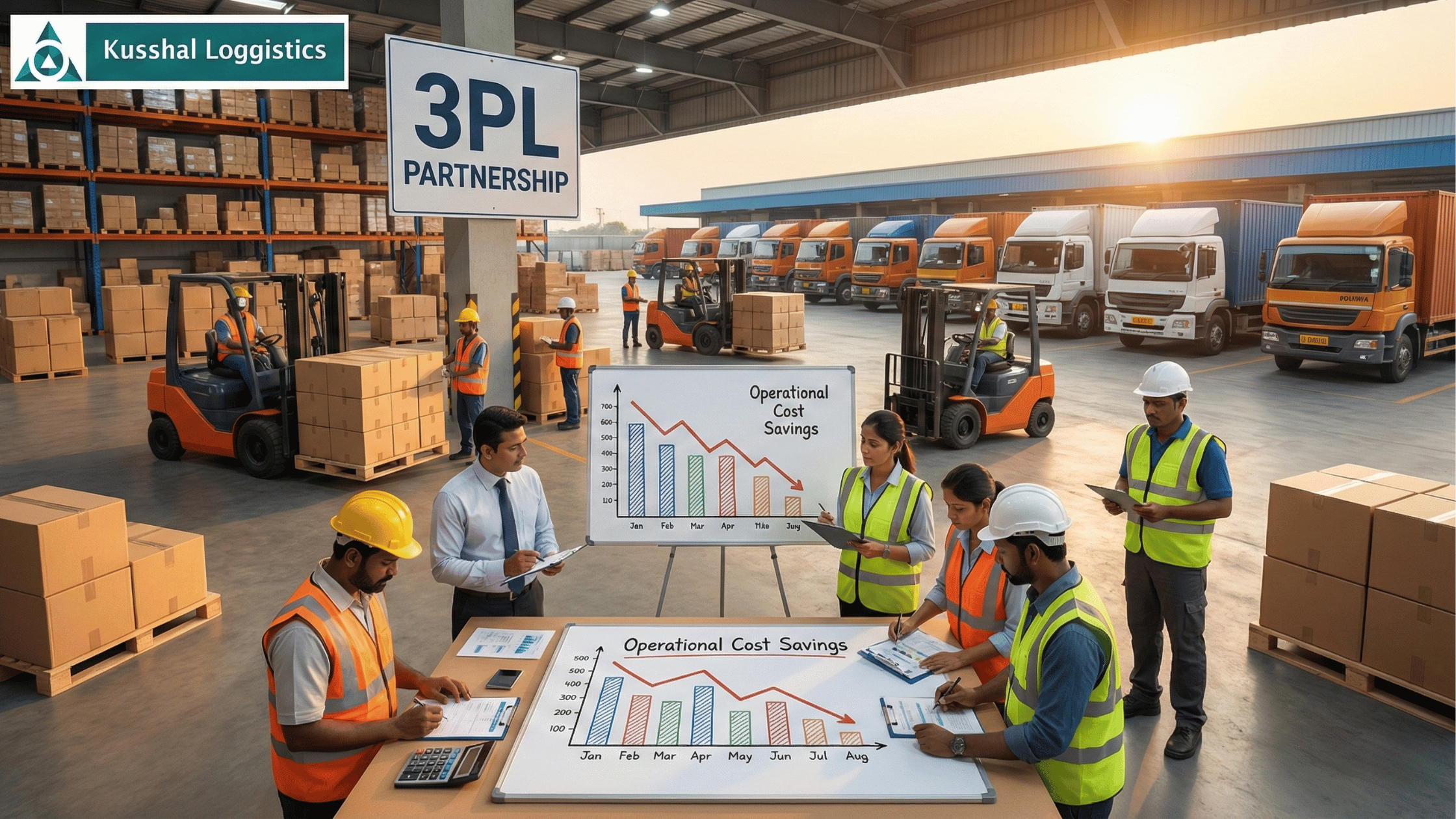
Every growing business tries to control cost without losing speed. That becomes harder when logistics is managed entirely in-house. Owning warehouses and running fleets may work for a short time. As operations grow, those same assets become harder to manage. Costs keep rising. Delays start increasing. Teams get stretched across too many tasks.
Outsourcing logistics to a 3PL company helps control that drift. It reduces overhead. It lowers infrastructure risk. It gives your team more time to focus on work that actually moves your business forward.
This is not a shortcut. This is a cost decision that supports long-term delivery stability.
Fixed assets begin to feel heavy:
Owning a warehouse sounds like control. In practice, it adds monthly cost that stays fixed even when business slows down. Empty racks still need rent. Repairs still need money. Staff still needs to be paid. That turns a logistics advantage into a drain on working capital.
When you outsource, you pay for what you use. Space can go up or down based on stock and demand. You do not get stuck with capacity you do not need. You do not lose out when volumes rise suddenly.
Vehicle ownership creates hidden cost:
Fleet management brings its own load. Fuel. Insurance. Road permits. Driver salaries. Maintenance. Even a single vehicle requires ongoing supervision. The vehicle may be parked, but the cost never stops.
A 3PL provider handles this. Vehicles are deployed based on requirement. Routes are pre-planned. Maintenance is their problem. You avoid vehicle downtime along with route failures. You stop spending on unused trips and urgent rentals.
Logistics staff needs constant supervision:
Running logistics requires trained manpower. Drivers. Loaders. Store keepers. Shift supervisors. You have to manage their attendance, their output, and their replacements. This becomes even harder during seasonal demand or unplanned absenteeism.
A 3PL setup already has backup teams. If one person is unavailable, another steps in. The service does not stop. You do not need to pause operations while hiring or training. That continuity saves you time along with stress.
Software cost keeps adding up:
Logistics needs systems. Order tracking. Stock visibility. Delivery alerts. These systems cost money. They also need upgrades. Many businesses delay this cost until the system fails. By then, errors are already affecting performance.
When you work with a 3PL provider, this layer is already handled. Their system tracks vehicles. Their reports show what moved. Their updates go out automatically. You do not need to build your own software. You do not need a team to run it.
Delays cost more than people realise:
Late deliveries create more than unhappy customers. They waste follow-up time. They cause last-minute firefighting. They also affect trust during client reviews or distributor meets.
Outsourced logistics runs on daily planning. Timings are clear. Routes are fixed. Handover is smooth. Fewer delays mean fewer calls. That reduces coordination pressure across your team. People work on dispatch, not damage control.
Returns become easier to manage:
When your own team handles outbound movement, returns feel like a reversal of everything. Vehicles must be arranged. Stock must be rechecked. Credit notes must be matched. If something breaks here, the cost of recovery is high.
A 3PL team already knows how to collect, sort, and restock returned items. They follow your process. They plug that into your reporting. Your internal team avoids rework. That reduces soft costs that often go unnoticed.
Cost per shipment becomes more predictable:
In-house logistics makes it hard to track true cost. Some costs are fixed. Others keep changing. When your shipment volume fluctuates, your unit cost becomes hard to calculate.
A 3PL contract gives you visibility. You know what you pay for space. You know what you pay per dispatch. You can break that down by zone, by volume, or by client. That helps you plan margins. That helps your team respond better to price pressure.
You stop building a logistics department:
Managing transport and storage means building a full department. You need hiring plans. You need training schedules. You need audits and reviews. If this is not your core work, it eats into your core time.
Outsourcing skips that. You get a team that already works across businesses. They know how to handle scale. They already track KPIs. You do not need to build processes from scratch.
Logistics stops interrupting meetings:
When logistics is managed internally, every problem becomes someone’s task. Someone needs to find a truck. Someone needs to speak to a driver. Someone needs to track a lost order. These interruptions take over planning calls. They stretch daily meetings. They slow everything down.
When you shift to a 3PL, these issues become offloaded. You deal with outcomes. Not incidents. That gives your teams room to focus on tasks that move the business forward.
Scale becomes less stressful:
Growth brings pressure. Orders spike. Stock moves faster. Old processes fail. A new warehouse takes time. A new driver needs training. Expansion stops feeling like progress.
With a 3PL setup, scale feels more stable. The provider already has extra capacity. They already serve new zones. You do not need to build again. You grow without gaps.
Cost does not rise as fast as volume:
Many businesses expect logistics cost to rise when orders increase. That happens only when systems are not ready. A 3PL company works across clients. That lets them manage cost better. They run the same warehouse across accounts. They use the same route to serve multiple drops.
You benefit from that scale. Your unit cost stays low. You deliver more without doubling spend.
Why this works better now:
3PL companies in India have improved. Warehouses are well-managed. Vehicles are GPS-enabled. Reports are clean. Support teams are responsive. This makes outsourcing less risky than before.
A company like Kusshal Loggistics supports warehousing along with transport. They help businesses reduce operational cost by removing the overhead of ownership. Their model is built to support growing businesses without slowing down decisions.
Final perspective:
Cost control is not about cutting corners. It is about spending on the right things. When logistics becomes a drag, the whole business starts moving slower.
Outsourcing to a 3PL provider helps fix that. You remove overhead. You remove delay. You remove firefighting. That leaves more time to plan growth instead of managing movement.
You run the business. Let someone else run the delivery.
FAQs
What are the key benefits of using a 3PL company in India?
You reduce warehouse costs along with vehicle ownership and manpower overhead. Your team gets more time to manage customers instead of fixing logistics.
How does a 3PL provider improve delivery timelines for my business?
Shipments are routed in advance. Vehicles are deployed based on demand. Delays reduce without stretching your internal team across multiple dispatch issues.
Can small and mid-sized companies also benefit from logistics outsourcing?
Yes. Most 3PL companies in India support variable space along with flexible dispatch. You pay for what you use, not for fixed capacity.